|
|
QUOTE OF THE MONTH
|
Be
thankful for what you have; you'll end up having
more. If you concentrate on what you don't
have, you will never, ever have
enough.
~Oprah
Winfrey
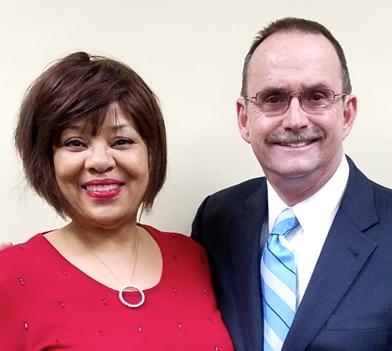
March's Quote of the Month Winner
Chief Judge Robert
J. Colombo, Jr. & Lila Lowe
Domestic Relations Specialist - FOC
Ms. Lowe has been employed with the Court
for 12 years.
|
|
STAND
GRADUATION
|
|
Pablo
Picasso stated, "Action is the foundational key to all
success." On February 22, 2017, The Supervised
Treatment for Alcohol and Narcotic Dependency
(S.T.A.N.D.) Program graduated seventeen individuals
who have proven that statement to be true. They focused
on individualized goals that were set by the program's
therapist and probation officers. In the words of
their generation, they "smashed" them.
Digging deep, they
found the determination to continually say "no" to the
substances that had taken control of their lives.
Participants were able to remain clean, focusing
on improving their education, and finding employment.
While the goals of the program are to eliminate
juvenile's substance abuse, improve school performance,
improve family relationships, and to reduce future
contact with the court, each participant took a
different road to arrive at the same
destination.
Under
the guidance of Judge Karen Braxton, all seventeen
individuals proved that they have a solid foundation to
proceed as a productive member of society.
At
graduation, the youth are honored with Pomp and
Circumstance at a ceremony held in the Friends'
Auditorium at the Detroit Public Library Main Branch.
The S.T.A.N.D. Program had the privilege of
having motivational speaker, Bill Joiner, offer words
of encouragement to the graduates. The S.T.A.N.D. Program
wishes to acknowledge the Judges, Commissioners, City
Council Members, State Legislators, and many volunteers
that attended to support the graduates and the success
of the program.
|
|
|
|
Civil Bench Bar Luncheon
|
With a capacity
crowd gathering of over 300, the Wayne County Civil
Division Bench and Auto Negligence Bar enjoyed a
luncheon discussion focused on collaborative effort
to meet the challenge of the surge in Auto Negligence
filings. An ongoing cooperative effort is planned to
address the best interests of litigants and their
counsel in meeting the No-Fault Statute's intent of
prompt payment of economic damages. Our intent
is the continued sharing of ideas for best practices
for attorneys and optimal use of judicial resources
towards effective and efficient resolution of these
issues.
|
 |
|
IT Makes it Happen
|
The Court
realizes that its employees are the number one
reason that it is successful. To recognize
the tremendous work that the staff does, a Court
Department, Committee, or Team will be selected
each month to receive a shout out in the
newsletter.
The Information
Technology team usually is behind the scenes making
things happen. In 2016, they completed
eFiling projects for the Asbestos docket and the
Criminal Division, among many other intensive
projects. In 2017, the IT team updated the
Court's website, a nominee for the 2017 National
Association of Court Managers' Top 10 Court
Websites Award. So, it's time for the IT team to
come from behind the scenes and receive a
shout out. Thanks to Mike Gruich, the CIO,
and the IT team for all they do!
|
|
Judge Toshihiko
Fujii


Judge
Toshihiko Fujii takes part in a mixed chorus group called
"Otomodachi" ("Oto" in Japanese means "sound" and
"tomodachi" means "friend"). The group mainly consists of
the Japanese people who live in and around Novi. On
March 12th, they performed in a concert in Novi and sang
"Cantique de Jean Racine" and some Japanese songs.
Their next concert will be held in the beginning of
June.
|
|
|
TO: ALL BENEFITS ELIGIBLE THIRD CIRCUIT
COURT EMPLOYEES
The
GoodRx website (www.goodrx.com)
provides helpful information about where and at
what cost prescription drugs are available and
may be purchased. In addition, the site
provides coupons that help reduce the cost of a
number of prescription medications.
|
 |
|
|
TO: ALL BENEFITS ELIGIBLE THIRD CIRCUIT
COURT EMPLOYEES
The
GoodRx website (www.goodrx.com)
provides helpful information about where and at
what cost prescription drugs are available and
may be purchased. In addition, the site
provides coupons that help reduce the cost of a
number of prescription medications.
|
|
Join our E-mail List and receive our monthly E-mail
newsletter from the Third Judicial Circuit Court
and stay informed.
Please send us your name and email address to
-
3cce-news@3rdcc.org
|
|
|
|
Greetings,
Spring officially
starts this month! It's the season of new
beginnings. The Court has continued to move
forward with many projects and has started new
ones. One of the most exciting new projects is
the discussion of a new Criminal Court complex.
This is an opportunity to have a
state-of-the-art facility, in which the Court will be
better able to serve the needs of the community.
In other exciting news, the Juvenile Mental
Health Court held its first graduation this
month. The Court is also pleased to recognize
and highlight two trailblazing women in recognition
of Women's History Month: The Hon. Lila
Neuenfelt (posthumously), the first elected woman to
be elected to serve as a judge of the Third Circuit
Court and the Hon. Mary Beth Kelly, the first woman
to serve as the Chief Judge of the Third Circuit
Court. We hope you enjoy the newsletters and
take time to share it with a friend or
colleague. Happy Spring!
|
|
|
Congratulations
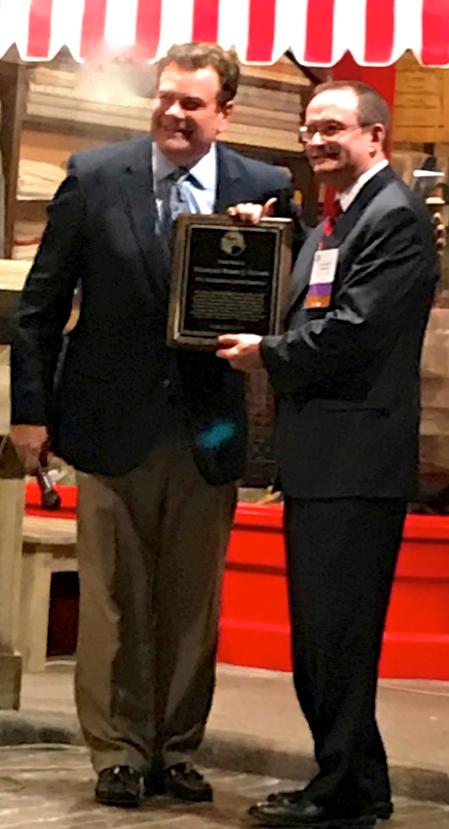
Chief Judge Colombo
Chief
Judge Colombo received the MDTC Judicial
Award of Excellence on March 9th.
This award is presented to commend one or
more state or federal judges for their
service to and on behalf of the state civil
bar, the legal profession, and the
public. This award is established to
recognize judges who have demonstrated the
highest standards of judicial excellence in
the pursuit of justice, while exemplifying
courtesy, integrity, wisdom, and
impartiality. It is awarded to the
judges who best exemplify that which brings
honor, esteem, and respect to the practice
of law. Judge Nanci Grant from
Oakland County was a recipient as
well.
|
|

We Salute
Judge Mary Beth Kelly
The Honorable
Mary Beth Kelly became the first female Chief
Judge of the Third Circuit Court in
2002. The Third Judicial Circuit of
Michigan is the largest trial court in Michigan
and during her tenure there were 63 sitting
judges. She received her undergraduate
degree from the University of Michigan-Dearborn
and her J.D. from Notre Dame Law School.
Chief Judge
Kelly served from 2002 through 2007 and initiated
reforms that are still impactful today. To
ensure that youth were properly represented in
juvenile justice matters, she implemented a law
firm model of appointment of counsel for youth in
neglect and delinquency matters. She
established the Wayne County Friend of the Court
Call Center to help ensure that the public
received timely responses to child support
inquires. The Call Center and the pods of
law groups still exist today and help the Court
operate efficiently. She also
partnered with the National Center for State
Court to take steps to ensure the racial
diversity of the Wayne County jury pool.
The Court continues to move forward with a
new jury system and initiatives to ensure racial
diversity of its jury pool.
On November 2,
2010, Judge Mary Beth Kelly was elected to the
Michigan Supreme Court. Justice Kelly
authored numerous opinions of major public
significance, including People
v Kolanek, a unanimous opinion which
provided the seminal interpretation of medical
marijuana use in Michigan, and the lead opinion
in Stand Up for Democracy v
Secretary of State which held that a
referendum petition must strictly comply with
relevant election laws. During her
tenure, she also served as the Administrative
Liaison of the Court for all treatment courts,
drug courts, and veterans' courts.
Additionally, she provided expertise and
leadership on child welfare and juvenile
justice issues on behalf of the Michigan
Supreme Court to the legislative and executive
branches.
Justice Mary
Beth Kelly served on the Michigan Supreme Court
from January 1, 2011 until her return to private
practice on October 1, 2015. She currently
practices at Bodman, PLC focusing on business
litigation, government relations, and public
affairs.
|
|

FOUR
YEARS OF HIGH MARKS FOR THE THIRD CIRCUIT
COURT
For
the fourth year in a row, the Third Circuit
Court received high marks from the public
regarding their experiences with the court.
Third Circuit Court users were asked
questions about whether the Court was
accessible, timely, and fair, and if they
were treated with courtesy and respect by
judges and court staff.
-
87% of court users said they were treated
with courtesy and respect by court
staff.
-
82% of court users said the way the judge
or referee handled their case was
fair.
-
84% of courts users said they understood
what happened in their
case.
"The
feedback from court users such as attorneys,
parties, and jurors is critically important
and helps shape decisions on how to improve
court operations," said Chief Judge Robert J.
Colombo, Jr. "I am very proud of the hard
work put in by our team and glad that their
work is recognized by others. We are
committed to being even more efficient and
focused on improving service to the
public."
The
Third Circuit Court is the largest trial
court in Michigan and handles criminal,
civil, and family matters. The survey
results for each division can be found on the
Court's website 3rdcc.org.
Developed
with input from judges and court
administrators statewide and tabulated by the
State Court Administrative Office to insure
accuracy, the survey enables courts to
identify strengths, provide positive feedback
to employees, and target areas for
improvement.
The
public satisfaction survey is part of a
statewide initiative of the Michigan Supreme
Court and the State Court Administrative
Office to measure and report on court
performance. From 2013 through 2016, nearly
100,000 surveys were completed in courts
throughout Michigan. Visit
www.courts.mi.gov
for
more information.
|
JUVENILE MENTAL HEALTH COURT CELEBRATES
THE FIRST GRADUATION
The
Juvenile Mental Health Court (JMHC)
celebrated its first graduation on March 8,
2017, at Michigan State University's
Detroit Center. MSU generously
allowed the use of its beautiful facility
on Woodward Avenue in Detroit. A pianist
from the Community Music Department of MSU
was on hand to play Pomp and Circumstance
on a Baby Grand Piano while the graduates
walked to their seats. The University
donated gift baskets to each graduate
filled with fruit, backpacks, sunglasses,
mugs, fruit, and other treats. Each
graduate also received a $50.00 gift card
to Meijer. The City of Detroit,
through MSU, also offered each graduate a
summer job with the Detroit Police
Department. The graduates had a
wonderful time and felt honored by the
event. The entire celebration was
recorded by the State Court Administrator's
Office, and a promotional film is being
produced.
Chief
Judge Robert J. Colombo, Jr. delivered the
opening remarks, followed by a brief
presentation by Charles Rivers, Director of
Community Relations for Southeast Michigan,
from MSU. Jonathan Edison delivered
the keynote address. Mr. Edison is a
Detroit native who has become a highly
sought after motivational speaker.
His address to the graduates was
dynamic, powerful, and packed full of
meaning for the youth.
Judge
Edward J. Joseph, the supervising Judge of
the JMHC, presented certificates of
completion to the graduates, explained the
program to the audience, and remembered
something special about each graduate.
Judge Joseph is deeply committed to
the young people and families we
serve.
The JMHC
has been in existence for just over one
year. In that time, 23 youth have
entered the program. Four graduated
on March 8, and the program continues to
grow. The JMHC is a problem-solving
court that combines judicial supervision
with community mental health services in an
effort to reduce future court contact,
out-of-home placements, and improve the
quality of life for participants and
families.
|
History: Judge Lila Neuenfelt, one of city's
early leaders and a role model for
women
By William Hackett
Apr 30, 2010
Editor's Note: This article was
written by William Hackett, a member of the
Dearborn Historical Commission.
Contemplating the history of our city,
a series of columns in the coming months will
include portraits of our history by different
authors from the Historical Museum.
The first of these, among several that
examine Dearborn women in politics, will feature
Lila Neuenfelt.
DEARBORN - 1941 headline announcing Dearborn Justice of
the Peace Lila Neuenfelt's election to the
Circuit Court announced, "Justice Dons a Skirt."
When members of the press agreed with her, they
referred to her "womanly wisdom," and when they
didn't, they wondered how a woman could be so
illogical at times and so completely to the point
at others.
But Neuenfelt was used to praise and
brickbats because she was a trailblazer. Born in
Lewiston, Mich. she went to Highland Park to live
with her sister and go to high school.
Working in a restaurant and a paint and
glass sales company to pay her way, she graduated
from Highland Park High School in 1919. Admitted
to the University of Detroit, she graduated from
its Law School in 1922 and had to wait six months
until her 21st birthday to be admitted to the
state bar. She became a voter, a lawyer and a
notary on the same day.
She was reportedly the youngest woman
lawyer in the United States. There would be many
more "firsts."
This was an era of women reformers.
Various women's suffrage associations, led by
such stalwarts as Elizabeth Cady Stanton, Susan
B. Anthony, Carrie Chapman Catt and Alice Paul,
passed resolutions, worked on state constitutions
and marched in parades for women's suffrage.
Finally, with the 19th Amendment, they
got the right to vote in 1920. But in many states
they could not serve on juries, hold office, own
a business or sign a contract without their
husband's permission.
Into this cultural setting this young
woman lawyer, hired as court clerk, moved into a
flat on Reuter Street, right off Michigan Avenue
in the village of Springwells.
In an oral history at the Haight
Archive of the Dearborn Historical Museum,
Neuenfelt said that Reuter had a sidewalk but the
street was not paved. "When it rained we parked
on Michigan Avenue." She was paid by the village
to type the new charter of the city of
Springwells. In this present age of spell check,
it is bracing to think back to the difficulty of
correction on typewriters of another era, while
reading her statement, "There could be no
mistakes on the final copy". Springwells went
from village in 1921 to city in 1924 and to the
newly established Fordson in 1925. To cap this
rapid emergence, Fordson merged with the city of
Dearborn (present west Dearborn) in January
1929.
Neuenfelt's emergence was similarly
rapid. Leo Schaefer had been elected judge
(justice of the peace) in Springwells village. He
and Lila had become close friends. He did not
want to continue to serve, so he suggested that
she run for judge in 1926. She felt that her association with
Schaefer would help her get votes, but she came
in second in the primary to Arthur Mains, an
insurance agency owner. So she walked and
campaigned house to house in the general election
and won. She was the youngest and first woman
elected justice of the peace in Michigan and was
covered in the newspapers and movie
newsreels.
The job called for her to work 50 days
a year, so she also opened a law office in the
city. When consolidation came, she and Schaefer
were elected fulltime municipal judges, a post
she held till 1941.
When Lila was elected to the Circuit
Court in 1941, Dearborn was booming. In the 20's
with the completion of the Ford Rouge plant,
Springwells went from 2,000 in 1921 to 25,000 as
the city of Fordson in 1926, and with the merger
of Dearborn and Fordson in 1929, the population
of Dearborn jumped to 50,000.
On the eve of the Great Depression
Henry Ford's Rouge plant employed 98,000 workers.
Workers came from all over the world and
trolleyed to the Rouge from all over Detroit. The
caseload of a justice of the peace, municipal
judge and circuit court judge must have been as
colorful. This was the era of prohibition, and
since it was governed by federal law, those cases
went to federal courts. However, there were many
cases involving local transgressions, such as
home brewing and operation of illegal
establishments.
Neuenfelt's personality livened up the
local scene. The relationship with Leo Schaefer
waxed and waned as they became competitors for
votes. She found Schaefer's clerk guilty of
contempt because he refused to turn over a file
of a person she believed should be tried in her
court.
When six bottles of whiskey were found
in her car she declared they had been put there
by an "enemy." Schaefer believed that she was
behind a recall petition against him in 1929.
They ran against each other for Congress in 1932,
splitting the Democratic vote and letting a
Republican candidate win in the midst of the
Roosevelt landslide.
A redhead who dressed fashionably,
Neuenfelt made good press. She married William
Purvis in 1933, and during her election campaign
in 1935, the Dearborn corporation counsel, James
Green, ruled that she had to use her married
name. She replied," I will run under any name I
choose." Greene sought got an initial ruling in
his favor from Michigan Attorney General Harry
Toy. Neuenfelt appealed to Toy that she had
always used her maiden name in public affairs.
Toy reversed himself and Lila was
vindicated.
In July 1940 Neuenfelt, as a municipal
judge, declared a Dearborn anti-union ordinance
prohibiting the distribution of handbills
unconstitutional, and her ruling was upheld on
appeal. A biography of Walter Reuther by Frank
Cormier and William Eaton saw this as the removal
of a major obstacle to UAW unionization of the
Ford Motor Company, and indeed on June 20, 1941,
the company signed a contract with the union.
Needless to say her action aided Neuenfelt in
getting labor votes when she ran for the circuit
court. Once on the bench however Lila was
evenhanded, deciding for and against labor and
management.
By the time Neuenfelt ran for the
circuit court, Orville Hubbard, soon to be long
time Mayor, was in the picture. In an interview
with David Good, Hubbard claimed that he had $110
to his name when Lila ran for Circuit Judge in
1941 and gave $100 to her campaign. He worked for
her election and in his colorful reminiscence
said: "Then, Lila worked like hell for me. She'd
take me around like I was a boyfriend. They had
stories that you could find me under her bed any
time you looked. Lila and I were real close but I
never even held her hand in my life. I treated
her with more dignity than Sir Walter Raleigh
treated the Virgin Queen." As president of the Dearborn Bar
association in 1941, Hubbard presented Lila with
a judicial robe upon her ascension to the circuit
bench. Later, as mayor, Hubbard hired her husband
as city assessor.
On occasion, Neuenfelt's caseload on
the circuit court directly touched Dearborn.
Susan Giffin's biography of Michael Berry, a
leader of Dearborn's Middle Eastern community and
chairman of the Wayne County Road Commission,
tells how as a young lawyer Berry was approached
by homeowners in the South End of Dearborn to
stop the Edward Levy Company from storing the
slag it received from the Ford Motor Company
behind their homes on Amazon Street. Berry went
to Judge Neuenfelt for an injunction. She said
she couldn't grant the injunction, but did issue
a restraining order that allowed Berry to
organize the families. The women of the community
blocked the road and stood in the way of the
trucks. Pictures were taken and Berry, realizing
that zoning ordinances were being broken, won the
case in court and the hearts of the people of the
South end. Neuenfelt much later went to work for
Berry's firm.
In September 1968 she retired and in
1969 moved to Ft Lauderdale, Fla. She died there
at age 79 in October, 1981.
Wayne Circuit Judge James Montante said
of her: "She made her mark as a masterful,
masterful judge. She was just a remarkable woman.
She handled maters crystal clear. She knew where
justice was."
With her death, Dearborn lost a
colorful character from its era of emergence -
one who helped women gained ground in their
emergence into politics.
|
|
Wayne
County Friend of the Court
Outreach
Within Reach
March
2017
INFORMATION IS POWER!
So come join us on one of the
following Thursdays
and get some power!
April 27, May 25,
June 22, July 27, August 24,
September 28,
October 26, November 30,
December 21,
2017
Clients are seen Noon until 3:00
p.m.
The Wayne County Friend of the
Court
Penobscot Building-645
Griswold
13th Floor -
SmartDetroit Conference Suites
Detroit, MI 48226
Staffed
by the
Detroit Bar Association Detroit
Legal Services Clinic
Detroit Bar Foundation Access to
Justice Program 313-961-6120 ext
210.
|
|
|
|
|